Kindergarten Writing Part II

Karen Harris and Colleagues’ Grades 1 and 2 Study
In our recent blog, Kindergarten Writers: Were We Wrong All Along?, I wrote about a ZoomSide™ Chat that made me rethink what young students can do as writers. I went into that conversation thinking I understood kindergarten writing. I left wondering whether many of us have been waiting too long.
Tony Dalton, a Pre-K through first-grade instructional coach in Hamblen County, said something in that conversation that stayed with me:
“The pencil can wait, but the mind can’t.”
After that blog went live, Dr. Karen Harris shared something that made the message even stronger. She reminded us that this is not just something educators are seeing in isolated classrooms; it also appears in research.
Karen wrote that she and her colleagues have worked with K–1 teachers who had great success with SRSD. She pointed to a study she co-authored with Drs. Young-Suk Kim, Soobin Yim, April Camping, and Steve Graham: “Yes, they can: Developing transcription skills and oral language in tandem with SRSD instruction on close reading of science text to write informative essays at grades 1 and 2.“
Karen noted that the opening of that article makes the same point: we can start with “the littles,” despite the long-held belief that writing should wait for later. She added that the student work, self-talk examples, and supplemental materials from the study show just how much these students achieved, that their teachers found they loved to write, and that writing could even be fun.
The Old Question: Should Young Students Wait?
For years, early writing instruction has been shaped by a debate that feels practical on the surface. Should young children first develop handwriting, spelling, oral language, sentence skills, and grammar before we ask them to compose? Or can we teach these skills while also teaching students how to plan, organize ideas, read closely, talk about content, and write for real purposes?
The “wait” argument sounds reasonable. Young children have limited working memory. Writing is hard. If students are still learning to form letters and spell words, asking them to compose may overwhelm them.
That concern is real. Writing does place a heavy cognitive load on young learners. But the better conclusion is not to wait — it is to design instruction that reduces that load while still asking students to think.
That is what SRSD Plus did in the Harris et al. study.
The researchers designed a multi-component approach that integrated three types of instruction at the same time: transcription skills such as handwriting and spelling; oral language skills such as vocabulary and sentence structure; and SRSD instruction for close reading, planning, and writing informative essays.
The study did not avoid the hard parts of early writing. It addressed them directly. Students did not stop working on handwriting. They did not ignore spelling. They did not skip vocabulary or sentences. But they also did not wait until those skills were fully mastered before learning to think, plan, and write. They learned these skills together. That is the shift.
What the Study Actually Did
This study included 93 first- and second-grade students in a high-poverty school. Students were randomly assigned within classrooms to either teacher-led SRSD Plus instruction or business-as-usual instruction (Writers Workshop). SRSD Plus was taught in small groups for 45 minutes, three times per week, for 10 weeks.
The instruction focused on close reading of science texts and writing informative essays. The science texts were aligned with grade-level science expectations, and students learned to read, mark up, plan from source texts, and write to inform.
This point matters. Students were not just writing about personal experiences. They were learning from text and using that learning to write. That is a demanding task even for older students. It requires understanding information, identifying important ideas, organizing those ideas, using academic vocabulary, and explaining what they learned in writing.
And they were doing this in first and second grade.
The researchers measured a wide range of outcomes: spelling, handwriting fluency, vocabulary, sentence proficiency, discourse knowledge, planning, writing quality, informative essay elements, number of words written, transition words, expository text comprehension, and use of source text.
The results were positive. The study found moderate to large effects in vocabulary, sentence proficiency, spelling, discourse knowledge, and writing outcomes. It also found large effects on planning, writing quality, writing length, and use of transition words.
In plain teacher language: the students improved in the skills we often worry they are not ready to manage. They improved in the basics. They improved in oral language. They improved in planning. They improved in the quality and length of their writing. They used more of the structures that help readers follow their ideas.
That is the research version of what Tony and Hannah were describing in the K–1 blog. The pencil matters. But the mind cannot wait.
This Was Not “Just Let Them Write”
One of the most important lessons from this study is that early writing does not improve simply because we ask young children to write more.
More writing matters. But more writing alone is not enough.
SRSD Plus was explicit, active, systematic, engaging, and highly supported. The supplemental materials describe instruction that began with students talking about how they felt about writing. Some students liked writing. Others said writing was hard. The teacher agreed that writing can be hard for everyone, including adults — and then helped students understand that writers improve by learning strategies and working hard to use them.
That opening matters. The teacher did not pretend writing was easy. She normalized the challenge and then gave students tools.
Students learned the TIDE mnemonic for informative writing:
T — Topic sentence ID — Big ideas E — Ending
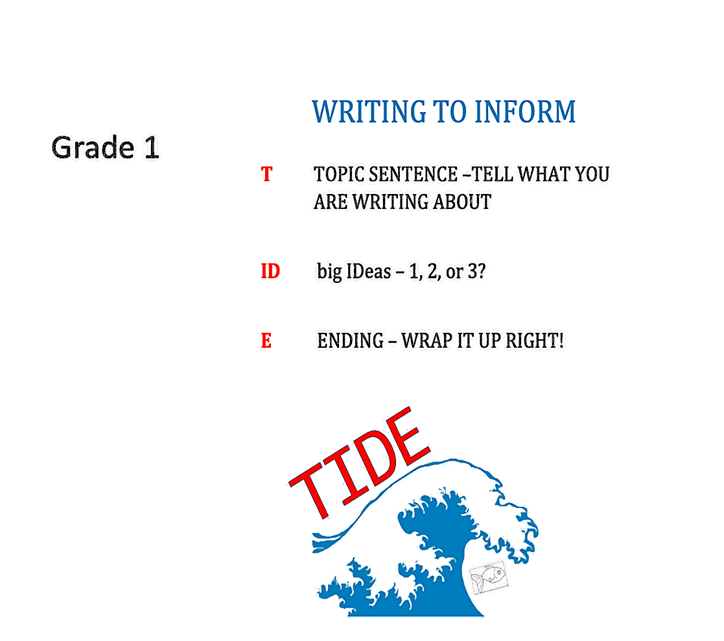
First-grade teachers could reduce the number of big ideas when that made sense for their students. SRSD does not require every child to march through the same path in the same way. Teachers adapt based on student needs.
Students also used TIDE folders, practiced the mnemonic with chants and movements, read science texts, identified topic sentences, found big ideas, discussed endings, built vocabulary, and talked about why each part mattered. That is not simple exposure. That is explicit instruction with purpose.
“The Pencil Can Wait” Does Not Mean “Ignore the Pencil”
Tony was right when he said, “The pencil can wait, but the mind can’t.” The Harris and colleagues study offers an important extension: while we should not delay thinking, we also should not ignore transcription.
The study did both.
Students received instruction in handwriting and spelling because transcription skills can constrain writing. When students use too much mental energy on forming letters or spelling words, they have less capacity for planning, generating ideas, and composing.
But the solution was not to teach transcription in isolation for years before students began composing. The solution was to teach transcription in tandem with oral language, close reading, planning, and writing.
That is a powerful distinction. It respects the reality of young learners’ development without reducing early writing to mechanics. It says: spelling and handwriting matter, and young students can still learn to think like writers.
This is where many schools may need to rethink their early writing block. If most of the time goes to mechanics, grammar, copying, or sentence-level work, students may not get enough practice organizing ideas and writing for meaning. But if students only write freely without explicit instruction, many will not develop the strategies they need. SRSD gives teachers a way to avoid both extremes. It teaches skills, strategies, processes, self-regulation, and writing for a real purpose.
Reading Came Before Writing
One of the study’s strongest findings is that students learned to read with a writer’s eye.
The supplemental materials describe SRSD instruction as “reading before writing.” Students discussed and dissected mentor texts and weaker texts. They learned to read with attention to how writers organize information, use vocabulary, connect ideas, and help readers learn.
Instead of treating reading and writing as separate blocks, the instruction connected them. Students read science text, marked it up, talked about important ideas, built vocabulary, and used what they gathered to plan and write. This helped them understand that informative writing helps readers learn facts. They studied openings, big ideas, clear facts, good sentences, linking words, word choice, and endings.
This is what “writing to learn” looks like in early education. It is not asking young students to produce long essays from nowhere, but teaching them how to gather ideas, discuss them, organize them, and explain them. That is exactly the kind of work many people assume first and second-graders cannot do.
But they can, with the right instruction.
Self-Talk Was Not an Add-On. It Was Part of the Work.
In the K–1 blog, one of the most powerful ideas was that young students were not just learning kindergarten writing — they were learning how to approach something hard. That is central to SRSD.
In the Harris study, students learned self-statements, or self-talk, to help them think of ideas, keep working, check their work, and handle frustration. Teachers modeled what writers can say to themselves when they get stuck, need to remember their goals, want to check their sentences, or want to recognize good work.
This is one reason SRSD feels different from many writing programs. It teaches students not only what to write, but it also teaches them how to manage themselves while they write.
That especially matters in the early grades because many students do not struggle with writing simply because they lack ideas. They struggle because writing feels overwhelming. They do not know where to start. They lose track of what comes next. They get frustrated. They decide, “I can’t do this.”
SRSD interrupts that pattern. It gives students words, routines, and strategies they can use when the work gets hard. Students recorded personal self-statements on the back of their folders. They learned that what they say to themselves matters and that helpful self-talk can help them grow as writers and learners.
This connects directly to the K–1 blog’s point about confidence. Confidence does not come from making writing easy. It comes from helping students succeed at something challenging.
The Student Work Tells the Story
The data matter. But the student examples make the findings real.
The supplemental materials include pre- and post-writing examples from first- and second-grade students. As Karen and her colleague Dr. April Camping note, these were not the very best samples — they were chosen because they are more representative of the students in the study. That makes them even more useful for teachers.
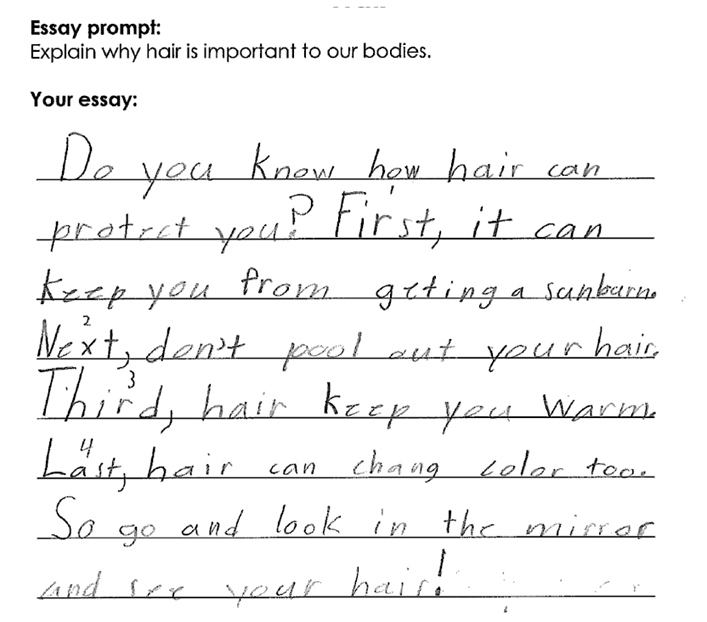
Pat: Grade 1
On the pretest, Pat declined to write about why animals have tails. He did not like writing on lined paper. His planning page had two attempts that trailed off.
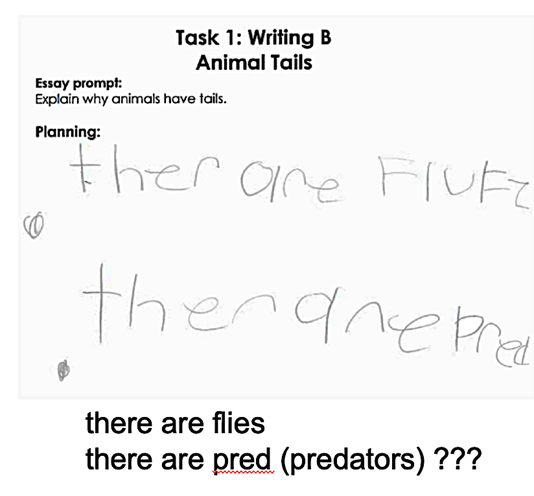
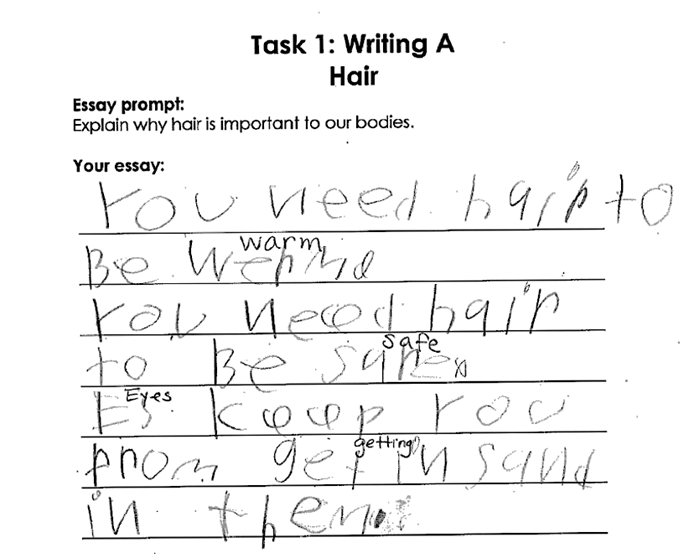
Pat’s pretest (left) and posttest writing (right). He moved from reluctance and minimal writing to putting ideas on paper and using information to explain.
By the posttest, Pat planned two big ideas and wrote:
“You need hair to be warm. You need hair to be safe. Eye lashes keep you from getting sand in them.”
This was not a polished final piece. It was a beginning. But it was a meaningful one. Pat moved from refusal and minimal writing to putting ideas on paper and using information to explain. That is the kind of growth teachers recognize immediately, not just a score — but a student crossing the line from “I won’t” to “I can.”
Chris: Grade 1
Chris’s pretest was two sentences: “All animals have tails. Some animals live in the wild.” No planning. No structure.
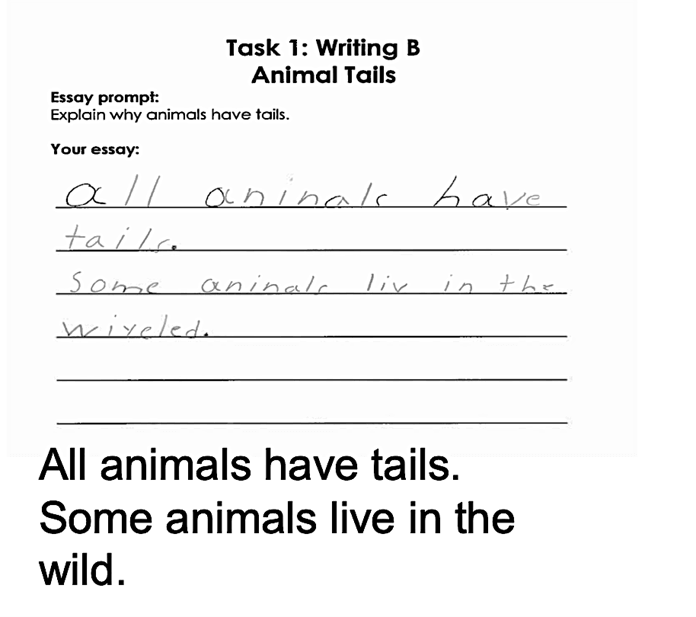
Chris’s pretest (left) and posttest writing (right). A clear shift in structure, purpose, and confidence.
By the posttest, Chris planned a topic, several big ideas with linking words, and an ending. This was a first draft, still needing revision. But it showed a real shift in structure, purpose, and confidence. The teacher’s next step would not be “he’s done.” It would be revision, focus, sentence work, and deeper explanation. SRSD does not mean students become finished writers after one unit. It means they have a foundation to keep building.
Navaeh: Grade 2
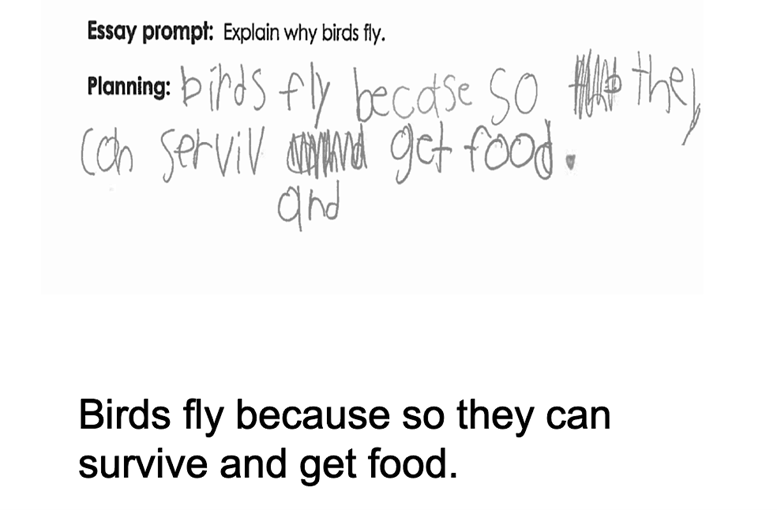
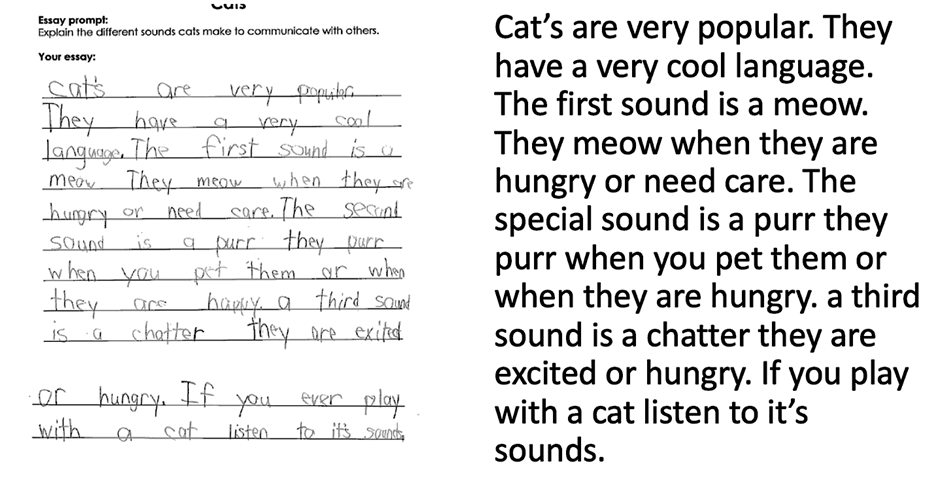
Navaeh’s pretest response about birds was a single sentence. By the posttest, she had planned a topic, a hook, four big ideas with varied linking words, and an ending and she wrote it all out. The supplemental notes showed that Navaeh used a self-made planning sheet and varied her linking words in the writing, rather than simply listing “first, second, third.” That is not just more writing. That is a writer making choices.
Young Students Can Plan
One of the biggest assumptions about young writers is that they cannot plan. This study challenges that assumption.
Students learned to use graphic organizers, but they also learned to move beyond them. They practiced making notes from the source text. Teachers described note-making as “caveman talk” — a simple way to help students understand that notes do not need to be full sentences.
This was hard for students, as the supplemental materials note. Making effective notes is hard even for older students. But the teachers did not avoid it. They modeled it, practiced it, and supported students over time.
That matters because planning is not just a writing skill — it is a thinking skill. When students plan, they decide what matters. They group ideas. They organize information. They prepare for a reader. Planning is also how students learn to enhance their literacy skills more broadly — it builds comprehension, vocabulary use, and the ability to communicate clearly.
The Study Supports What Teachers Are Seeing
The K–1 blog was built from classroom experience. It showed what happens when a teacher and coach stop waiting and start supporting young students as thinkers. The Harris study gives that classroom story a research foundation.
In the K–1 blog, Hannah Moore described starting with high expectations, oral writing, talking, thinking, organizing ideas, and language. She saw students’ confidence grow as their language grew. The study did something similar in Grades 1 and 2 — combining oral language, vocabulary, sentence work, transcription skills, close reading, planning, and informative writing, with growth across all of those areas.
In the K–1 blog, Tony described SRSD as a “cheat code for the brain” because it helps reduce cognitive overload. The study supports that by designing instruction that directly addresses transcription and oral language while teaching higher-order composing skills.
In the K–1 blog, the key realization was that structure does not lower the ceiling — it raises it. The study gives us evidence for that. The students were not limited by the structure. They used it to do more.
This Was Teacher-Led, Not Script-Driven
One point from the supplemental materials deserves special attention: SRSD is a “problem-solving method of instruction.” It is not scripted. Teachers must be in charge.
That is essential for early grades. Young students vary widely. Some are ready to write more. Some need more oral rehearsal. Some can use three big ideas; others may need one or two. Some can use a hook; others need to focus first on the topic and facts.
The study allowed for those decisions. First-grade teachers could reduce the number of big ideas when appropriate. Teachers could decide whether to introduce hooks early, later, with some students, or not at all. Students could use supports and gradually move toward independence.
That flexibility is not a weakness — it is part of what makes SRSD powerful. The structure stays clear, but the teacher adjusts the support. That is exactly what good writing instruction requires.
What This Means for Schools
This study should give us pause before we say, “They are too young.”
Maybe they are too young to write independent essays without support. Maybe they are too young for long writing assignments that assume they already know how to plan, organize, spell, form letters, and manage frustration on their own.
But they are not too young to learn how writing works, to talk about ideas, study strong texts, learn vocabulary, use self-talk, plan, and write to teach someone else what they learned.
The question is not whether young students can do this work. The better question is whether we are giving them instruction that makes it possible.
For school leaders, the implications are real. If early writing instruction focuses mostly on handwriting, spelling, and isolated sentences, students may miss the chance to develop the deeper thinking behind writing. If early writing instruction relies mostly on open-ended writing time, students may not get enough explicit support. If writing is treated as something students will “grow into,” we lose valuable time.
SRSD offers a more complete path — one that integrates writing activities to cultivate both students’ skills and their thinking.
A Beginning, Not an Ending
One of the most honest parts of the supplemental student examples is that the authors keep asking: “Where would you go next?”
The student writing was not perfect, nor was it supposed to be. These were first drafts, often produced under timed research conditions. The supplemental notes even state that teachers do not need to use timed writing in regular instruction — the time limit was a research requirement. Most students could likely do more without it.
That is an important reminder for teachers and school leaders. The goal is not to look at young students’ writing and ask, “Is this finished?” The goal is to ask, “What does this tell us about what the student now understands, and what should we teach next?”
For Pat, the next step might be adding a clearer topic sentence or expanding one idea. For Chris, it might be staying focused on the topic and revising for clarity. For Navaeh, it might be stronger sentence boundaries or more complete explanation. That is formative assessment in action. Student writing tells the teacher where to go next. SRSD gives the teacher a structure for getting there.
The Bigger Lesson: Stop Underestimating
Karen Harris has noted that she was struck by how teachers like Hannah and Tony took ownership of SRSD while keeping its values and essential characteristics intact. That matters because it captures what strong implementation looks like. SRSD should not become a rigid script, a stack of worksheets, or one more program teachers “cover.” When teachers understand it deeply, they can adapt it responsibly — bringing it to life for their students while keeping the essential features intact. That is what we saw in Hamblen County. That is what Harris and colleagues studied in Grades 1 and 2.
For too long, many educators have assumed that meaningful writing instruction, a truly comprehensive approach to writing must wait until students are older. The Harris study challenges that belief. The K–1 classroom examples challenge it too.
Young students can do far more than many people think. They can learn strategies, use self-talk, talk through ideas, mark up text, plan, write to inform, build confidence, and begin to see themselves as writers. But they need adults who stop waiting. They need us to stop treating early writing as a choice between mechanics and meaning. They need both.
Young writers need instruction in handwriting and spelling, but they also need vocabulary, sentence work, oral language, modeling, rich discussion, mentor texts, planning, and self-regulation. Most of all, they need teachers who believe the work is possible and know how to support it.
Tony was right: the pencil can wait, but the mind can’t. Karen Harris and her colleagues showed us something equally important: when we teach the pencil, the language, the strategy, and the thinking together, young students can do far more than many of us believed.
Yes, they can. And once we know that, we have a responsibility to teach as if it is true.
References
Harris, K. R., Kim, Y.-S. G., Yim, S., Camping, A., & Graham, S. (2024). Yes, they can: Developing transcription skills and oral language in tandem with SRSD instruction on close reading of science text to write informative essays at grades 1 and 2. Contemporary Educational Psychology, 76, 102150. https://www.sciencedirect.com/science/article/abs/pii/S0361476X23000048
Harris, K. R., Kim, Y.-S. G., Yim, S., Camping, A., & Graham, S. (2024). Supplemental material 3: Student work samples and instructional materials [PowerPoint slides]. ResearchGate. https://www.researchgate.net/publication/387025930

About the Author
Randy Barth is CEO of SRSD Online, which innovates evidence-based writing instruction grounded in the Science of Writing for educators. Randy is dedicated to preserving the legacies of SRSD creator Karen Harris and renowned writing researcher Steve Graham to make SRSD a standard practice in today’s classrooms. For more information on SRSD, schedule a risk-free consultation with Randy using this link: Schedule a time to talk SRSD.


