Teaching Argumentative Writing: From “I Think” to “Here’s Why”

What a 2026 Meta-Analysis Says About Evidence-Based Writing Strategies
A student writes, “Solar power is good because it helps the planet.”
It’s a start. The student has an opinion and a reason. If we ask for another reason, we might get, “It saves money.” If we ask for a conclusion, we might get, “That is why we should use solar power.” Soon, the student has something that looks like an opinion essay.
But has the student learned to build an argument that can stand up in a debate?
Not yet. A recognizable structure can hide unfinished thinking. “Solar power helps the planet” may be true in a particular sense, but what does the student mean? How does it help? What evidence supports that reason? Does the student understand the information well enough to explain it to a reader?
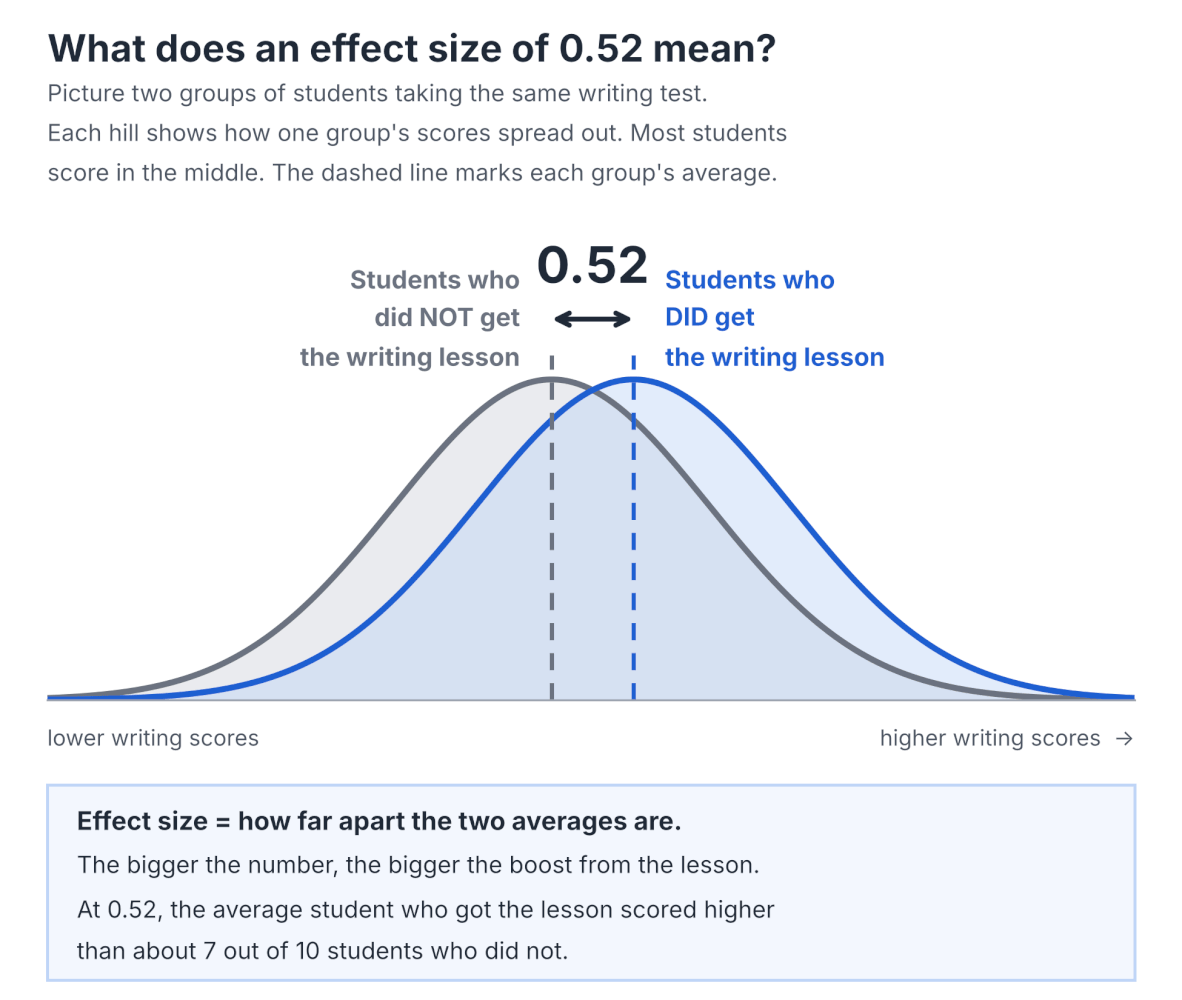
As teachers, we can see the next steps. Our students often cannot, at least until we teach them. A 2026 meta-analysis of argumentative writing instruction by Steve Graham, April Camping, Yucheng Cao, Alyson Collins, and Stephen Ciullo gives us a timely reason to look closely at how we teach those steps. The researchers examined instruction for students in Grades 1–12 across 185 treatment and comparison conditions involving 22,216 students. Overall, instruction improved students’ argumentative writing, with an average effect size of 0.52. Among the approaches studied, strategy instruction showed particularly strong results, and studies using Self-Regulated Strategy Development (SRSD) showed substantial benefits.
The finding is encouraging. It also deserves a careful reading. The lesson for teachers is more useful than “have students use a graphic organizer” or “give them more opinion prompts.” We need to help students understand what an argument asks them to do, show them how a writer makes decisions, and support them as they learn to make those decisions for themselves.
Teaching Argumentative Writing Means More Than a List of Parts
Opinion and argumentative writing can look different across grade levels. A second grader may write about whether the class should plant a garden. A middle school student may weigh evidence about school start times. A high school student may address competing interpretations of a historical event. The expectations grow more demanding, but each writer faces a version of the same challenge: take a position and help a reader understand why it deserves consideration.
Many students learn to identify a topic sentence, reasons, and a conclusion. That knowledge helps. Yet naming the parts does not tell a student how to choose a defensible position, generate a relevant reason, use information accurately, or explain the connection between evidence and a claim.
Return to our solar power example. Suppose the student finds a source explaining that solar panels generate electricity without burning fossil fuels while they operate. A teacher could simply tell the student to add that fact. Another instructional approach is to model the decision behind using it, a core feature of evidence-based SRSD instruction:
“My reason says solar power helps the planet. This information explains one way it might help: generating electricity without burning fossil fuels during operation. I need to put that in words my reader will understand. Then I need to explain how it supports my position. I also need to be careful. This fact doesn’t mean solar panels have no environmental costs at all.”
Now the teacher has made several invisible acts of writing visible. The writer checked whether the information fit the reason, translated it into an explanation, connected it to the claim, and avoided saying more than the evidence supported.
A graphic organizer can hold the student’s plan. It cannot do that thinking for the student. The teacher’s modeling and guided practice help the student learn what to put in the organizer, why it belongs there, and how to turn the plan into writing that makes sense to someone else.
What the Meta-Analysis Found About Argumentative Writing
A meta-analysis combines the results from many studies, which can give a broader picture of patterns and outcomes than any single study can. The authors of this meta-analysis were interested in studies that tested approaches to teaching argumentative writing, a term they defined broadly to include opinion and persuasive writing.
Across the studies, argumentative writing instruction had a positive effect on writing outcomes immediately after instruction, with an average standardized effect size of 0.52. The researchers also reported a positive effect on content learning, 0.38, in the smaller set of comparisons that measured it. These figures describe average differences between instructed students and comparison groups in standard deviation units. They are not percentage gains or guarantees of what any particular classroom will achieve.
The results for strategy instruction are especially relevant to teachers. Across 56 treatment and comparison conditions, teaching students strategies for planning, drafting, or revising arguments produced an average effect of 0.78 across writing outcomes. Forty of those used SRSD and their average effect across writing outcomes was 0.90, about twice the average for other strategy approaches. Within the SRSD comparisons, effects were 1.23 for writing quality and 1.24 for argument genre elements.
These two outcomes capture different things. Writing quality reflects how well the whole piece communicates. Genre elements show whether students included what an argument needs such as reasons and evidence. We want both: a student can check every box on a list and still leave a reader unconvinced or confused. In the meta-analysis, SRSD showed large effects for both writing quality and genre elements.
The authors also found that SRSD had a positive effect on writing outcomes measured after instruction ended, 0.74. That result is promising, but follow-up assessments in this review extended no longer than 15 weeks, and relatively few studies measured them. This meta-analysis alone cannot tell us whether gains will last across multiple school years.
None of these numbers evaluates SRSD Online’s courses specifically. They describe the body of research on teaching argumentative writing, including SRSD. For educators, the value lies in understanding what effective instruction asks teachers and students to do.
What a Teacher Can Make Visible
Imagine returning to that first solar power draft during an opinion writing lesson. Before students write, the teacher might invite a brief discussion: What does our class already know about how electricity is made? What would we need to find out before arguing that a school should use solar power? Students may disagree, ask questions, or discover that some reasons are easier to support than others with clear evidence.
The teacher can then model a plan in front of the class by thinking aloud. “I’m thinking about a school deciding whether to install solar panels. My opinion is that the school should consider them. One reason concerns how the electricity is generated. Another might concern costs over time, but I don’t yet have enough information to make that second reason confidently. I’ll mark it as a question to investigate.”
This shows students that writers do not have to pretend they know everything before they begin. Writers notice gaps, seek information, and adjust their plans. They choose reasons because those reasons help make a case, not because they need to fill three spaces on a graphic organizer.
After modeling, the teacher and students can write an explanation together, the “we do” step. A student might suggest, “Solar panels are good for the environment.” The teacher can ask, “What information have we read that would help a reader understand that?” Another student may recall something from the class reading: generating electricity without burning fossil fuels during operation. Together, the class can decide how to explain how that point supports the proposal for the school.
Later, students practice with support. The teacher listens for the decisions students make: Can they explain why they chose a reason? Can they tell whether a detail supports it? Can they notice when an explanation skips a step? As students gain control, the teacher reduces the support. The goal is for students to take ownership of the process, including planning, checking their work, and revising when their argument does not yet say what they intend.
Self-regulation is what sets SRSD apart from other strategy instruction. A student needs more than knowledge of an argument’s structure. The student also needs ways to set a goal, monitor progress, manage a demanding task, and keep working when a first attempt falls short. Those actions do not appear automatically because a teacher hands out a mnemonic. Teachers teach and model them, practice them with students, and help students at every level, including struggling writers use them independently.
The Study Also Points Beyond One Approach
The meta-analysis did not find that strategy instruction was the only useful way to improve argumentative writing. The researchers reported positive average effects for several approaches, including discussion about a topic or argument, peers working together, knowledge building, prewriting, feedback, and goal setting. The studies varied, and their results should not be treated as a ranking of interchangeable methods. Still, the range of findings should interest any teacher who has watched a productive conversation change what students are ready to write.
Discussion, reading, planning, and writing can serve different purposes within a lesson. Students may talk through an idea to discover what they think. They may read source texts to learn enough about a topic to make a responsible claim. They may use a strategy to organize and develop their thinking. They may review a draft against a goal and revise it. Good instruction helps students understand how those actions work together within the writing process.
The findings also matter for teachers who want writing to strengthen learning in content areas such as science and social studies. The review found a positive average effect on content learning among the studies that measured it. That finding supports giving students opportunities to work with ideas as they write arguments about what they are learning. It does not mean that assigning an argument about any topic will automatically improve students’ knowledge. They need access to sound information and instruction that helps them use it.
The authors also identify questions researchers still need to answer. Many SRSD studies in this review focused on language arts, and most taught students to plan arguments. The authors call for more research on revision, arguments based on source material, knowledge building, and argumentative writing within academic subjects. Teachers already face these demands in their classrooms. The research tells us what has been studied well and where we should stay curious.
Read Student Writing for the Decisions Behind It
One practical way to use this research is to read a student draft with a slightly different set of questions. Instead of stopping at “Does this essay have a position, reasons, evidence, and a conclusion?” ask:
- Can I tell what the student wants the reader to believe?
- Do the reasons actually support that position?
- Does the student explain the evidence, or simply place it in the paragraph?
- Where might the student need more knowledge before writing confidently?
- Could the student explain why they made these choices?
Those questions can guide the next lesson. If students have relevant ideas but cannot organize them, model planning. If they can list reasons but cannot explain them, write an explanation together and talk through each decision. If their arguments depend on unsupported statements, make time to read and discuss the topic. If students can improve a draft only when the teacher points to every problem, model how a writer checks the draft against a goal.
Teachers do not need to address every issue at once. They need to identify what their students are ready to learn next and provide enough support for them to succeed at it. Over time, students should be able to do more of that work on their own.
I’m personally proud to highlight that Dr. April Camping is part of the SRSD Online team and a coauthor of this meta-analysis. She worked with Steve Graham, Yucheng Cao, Alyson Collins, and Stephen Ciullo to bring a substantial body of argumentative writing research into clearer view for educators. Her contribution reflects the kind of careful connection between research and classroom practice that matters to our work. It is an honor to work with her.
The meta-analysis gives us good reason to teach argumentative writing deliberately. It also reminds us to keep the full task in view. A student’s first “I think” is an opening. Our job is to help that student learn to ask, “What makes me think so? What evidence can I show my reader? Have I explained the connection? And does my argument hold up when I read it again?”
That is how a list of reasons begins to become an argument.
Read the research: Graham, S., Camping, A., Cao, Y., Collins, A., & Ciullo, S. (2026). Teaching argumentative writing: A meta-analysis with school-aged students. Journal of Educational Psychology, 118(7), 1079–1107. https://doi.org/10.1037/edu0001034

About the Author
Randy Barth is CEO of SRSD Online, which innovates evidence-based writing instruction grounded in the Science of Writing for educators. Randy is dedicated to preserving the legacies of SRSD creator Karen Harris and renowned writing researcher Steve Graham to make SRSD a standard practice in today’s classrooms. For more information on SRSD, schedule a risk-free consultation with Randy using this link: Schedule a time to talk SRSD.


