SRSD Writing Instruction: Why Modeling Is So Powerful
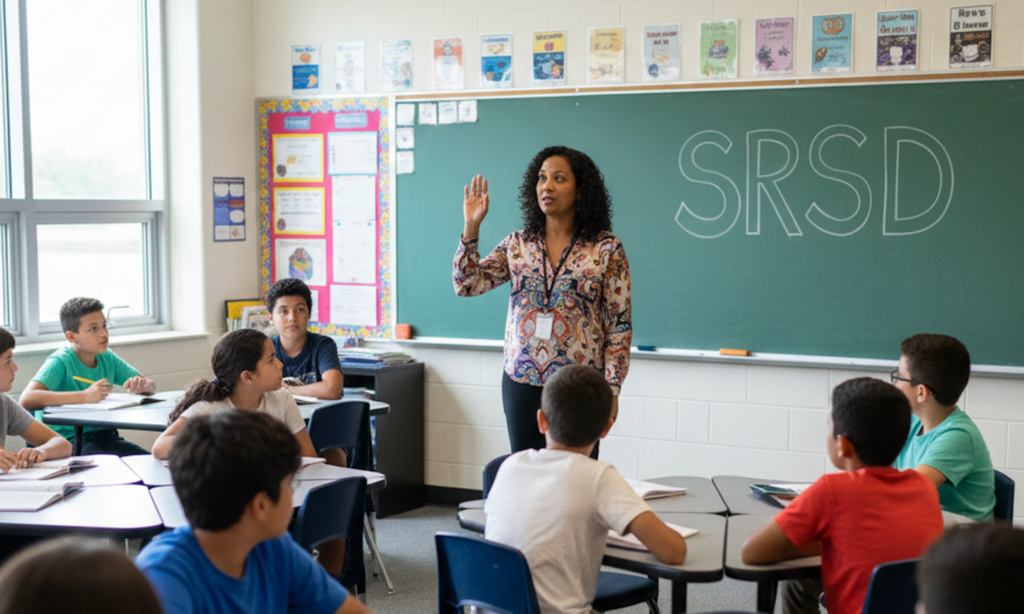
How SRSD Researcher Barbara Friedlander Shows Teachers What Strong Writing Instruction Really Looks Like
When teachers talk about teaching writing, the conversation often centers on what students produce: sentences, paragraphs, essays. But experienced educators know that strong writing instruction is not just about outcomes. It is about teaching students how writers think.
That is why modeling, specifically modeling through think-aloud writing strategies, sits at the heart of SRSD writing instruction.
In a recent SRSD ZoomSide Chat™, SRSD researcher and practitioner Barbara Friedlander walked teachers through one small part of Self-Regulated Strategy Development (SRSD): modeling. While it is just one stage of the framework, Barbara makes a compelling case that it is often the most impactful.
As she explains, even when teachers understand SRSD strategies, student growth accelerates when teachers make their thinking visible, showing students not just what to write, but how to approach writing as skilled writers do.
This blog unpacks the core principles of SRSD modeling as Barbara teaches them, helping educators understand what modeling looks like in practice and why it works so powerfully for students across grades and content areas.
Watch the video here: Barbara Friedlander SRSD ZoomSide Chat™: Modeling
Writing Is Still a Life Skill, Even Now
In today’s classrooms, teachers are navigating rapid change. AI tools can generate text. Students can dictate ideas. Technology can support drafting.
Yet writing remains essential.
Students still need to plan ideas, organize information, and communicate clearly for a specific audience. As Barbara notes, students will need writing skills for “a proposal, a grant, a brief, or Google Slides.” They also write daily emails, texts, and social media posts, often without realizing they are practicing writing.
The question is not whether writing still matters. The question is how to teach writing in a way that truly works for students.
Self-Regulated Strategy Development offers an answer because it teaches students writing strategies for students that mirror what skilled writers already do. Modeling is how students gain access to those strategies.
Why Students Get Stuck Before They Ever Write
Many students struggle with writing long before they put words on the page.
Teachers see this every day:
- Students freeze when asked to write
- They avoid starting
- They wait for help or answers
- They shut down emotionally
Barbara describes years of working with students who had learned that if they waited long enough, “the teacher will just tell me what to do.” By the time many students receive additional support, they have become dependent rather than independent.
SRSD addresses this directly through explicit writing instruction and gradual release writing instruction. Modeling is where that release begins.
What Modeling Means in SRSD
Modeling in SRSD is not simply showing students a finished piece of writing. It is a deliberate, intentional think-aloud in which the teacher writes in front of students and verbalizes the thoughts, decisions, struggles, and strategies that occur while writing.
Barbara describes modeling as “a way to expose your thoughts and what good writers do.” Skilled writers talk to themselves constantly as they write. Students rarely hear that internal dialogue unless teachers make it visible.
This practice is not anecdotal. The What Works Clearinghouse identifies modeling and think-alouds as a core component of SRSD because they allow teachers to explicitly demonstrate strategy use, self-regulation, and goal setting, key elements of evidence-based writing strategies.
Modeling Is About Self-Regulation, Not Just Mnemonics
Many teachers associate SRSD with mnemonics like POW, TREE, or TIDE. These tools matter, especially for students with working-memory or language-processing challenges.
But Barbara is clear: “The mnemonic is not actually the secret to SRSD.”
The real power lies in self-regulation in writing. Teaching students how expert writers set writing goals, plan, and monitor progress:
- Plan
- Monitor progress
- Encourage themselves
- Manage frustration
- Adjust strategies based on the task
Modeling is where students learn these behaviors, which are essential for developing strong writing skills.
The Gradual Release Begins With Modeling
SRSD follows a gradual release of responsibility model. Teachers begin by doing most of the cognitive work, then gradually shift responsibility to students.
Barbara explains that this release starts with:
- Building background knowledge
- Understanding the genre
- Seeing examples and non-examples
- Watching the teacher model the writing process
Only after this foundation and receiving initial feedback do students move into collaborative writing, peer practice, and independent writing.
Modeling gives students a roadmap before they are asked to drive on their own.
Five Core Components of Effective SRSD Modeling
Barbara designs her modeling carefully, often planning or scripting what she will say. Over time, teachers internalize the process, but early precision matters.
She consistently focuses on five key areas.
1. Modeling How Writers Get Started
Getting started is one of the biggest barriers for struggling writers.
Barbara intentionally voices that struggle: “This might be too much work. I don’t know how to get started.”
Then she models the recovery: “Oh wait—I remember POW and TREE.”
Students learn that uncertainty is normal and that strategies exist to move forward.
2. Modeling Strategy Use in Real Time
Modeling shows students how to use strategies to enhance their writing skills, not just name them.
Barbara writes “POW” at the top of the page and “TREE” down the side, explaining that these tools help her stay organized and focused during the writing process.
This is critical for explicit writing instruction. Students see strategies as thinking tools, not worksheets.
3. Modeling Positive Self-Talk
Many students engage in constant negative self-talk:
- “I can’t do this.”
- “Writing is too hard.”
- “Everyone else is better than me.”
Barbara models productive self-statements: “I can do this.” “This is hard, but I have a plan.”
She also discusses intentionally modeling negative thoughts, then analyzing why they are unhelpful. This teaches students to replace them with more productive language.
4. Modeling Goal Setting and Monitoring
Goal setting is often overlooked in teaching writing, but Barbara emphasizes that it is a life skill.
During modeling, she pauses to check progress: “I said I was going to have eight parts. Let me count.”
Students learn how expert writers monitor their work as they write, not just after they finish.
5. Modeling How Writers Handle Distraction and Frustration
One of the most powerful aspects of Barbara’s modeling is her handling of interruptions and emotional derailments.
In one example, she becomes distracted mid-writing, then redirects herself: “I cannot think about that right now. I won’t get all the points if I do that.”
Students learn that distraction happens and that writers can regain control.
Modeling Is Interactive and Flexible
Barbara emphasizes that modeling does not have to be one uninterrupted performance.
Some classes benefit from stopping frequently to discuss what they noticed. Others can sustain longer models. Teachers can pause, analyze self-statements, then continue.
This flexibility allows modeling to remain high-engagement, even for students with limited attention spans.
When Modeling Works, Students Generalize
One of Barbara’s most powerful examples comes from students who transferred self-regulated strategy development (SRSD) strategies years later without prompting.
Middle school teachers noticed that students who could write independently all shared one experience: SRSD.
They didn’t need reminders. They knew what to do when given an assignment.
That transfer is the goal of SRSD writing instruction. Modeling makes it possible.
Modeling Improves Motivation and Independence
Barbara consistently sees changes in student motivation after SRSD instruction.
Students want to write because they finally understand how writing works. Research confirms that SRSD improves planning, organization, revision, motivation, and independence.
Modeling removes the mystery from writing. Confidence grows when students know what expert writers do.
Modeling Works Across the Curriculum
SRSD modeling is not limited to ELA classes.
Barbara describes supporting a science teacher who struggled with lab writing. After modeling his own thinking (planning, organizing, and self-talk) student writing improved.
Writing is thinking. Modeling teaches thinking in any subject.
Modeling Supports Teachers, Too
Teacher confidence matters for retention.
Barbara notes that when teachers know exactly how to teach writing and see student results, they stay engaged in the profession. SRSD modeling gives teachers clarity and direction.
It shows them how to teach writing, not just what to assign.
There Is No Fixed Timeline. And That’s the Point
Teachers often ask how long to stay in each SRSD stage.
Barbara’s answer is consistent:
It depends on the students.
Some students need extended modeling. Others move quickly into collaboration. SRSD is flexible, responsive, and student-centered.
Final Takeaway for Teachers
From our experience, some teachers think SRSD Modeling is an extra step in writing instruction. Others think SRSD modeling is too tricky. What does Barbara think? SRSD modeling is the heart of the framework.
When teachers model:
- Students learn how writers think
- Self-regulation replaces avoidance
- Strategies become usable tools
- Independence becomes achievable
As Barbara says, modeling lets students “see into your brain.”
That is how students learn to write—and why modeling remains one of the most powerful evidence-based writing strategies teachers can use.
About Barbara Friedlander
Barbara’s leadership as an Inclusion Instructor in Maryland and a Nationally Board-Certified Special Education teacher has been instrumental in incorporating SRSD into classroom practice. With over two decades of experience in special education, she has co-authored influential SRSD books, including the widely acclaimed Powerful Writing Strategies for All Students. Her contributions have earned her recognition, including the Learning Disabilities Association Sam Kirk Educator of the Year award for 2024. As an SRSD training and educational policy leader, Friedlander’s influence shapes inclusive educational practices and co-teaching strategies.
Our favorite study featuring Barbara Friedlander is: Bring Powerful Writing Strategies Into Your Classroom! Why and How (2013)

About the Author
Randy Barth is CEO of SRSD Online, which innovates evidence-based writing instruction grounded in the Science of Writing for educators. Randy is dedicated to preserving the legacies of SRSD creator Karen Harris and renowned writing researcher Steve Graham to make SRSD a standard practice in today’s classrooms. For more information on SRSD, schedule a risk-free consultation with Randy using this link: Schedule a time to talk SRSD.


