Implementing SRSD in the Classroom: A Teacher’s Guide
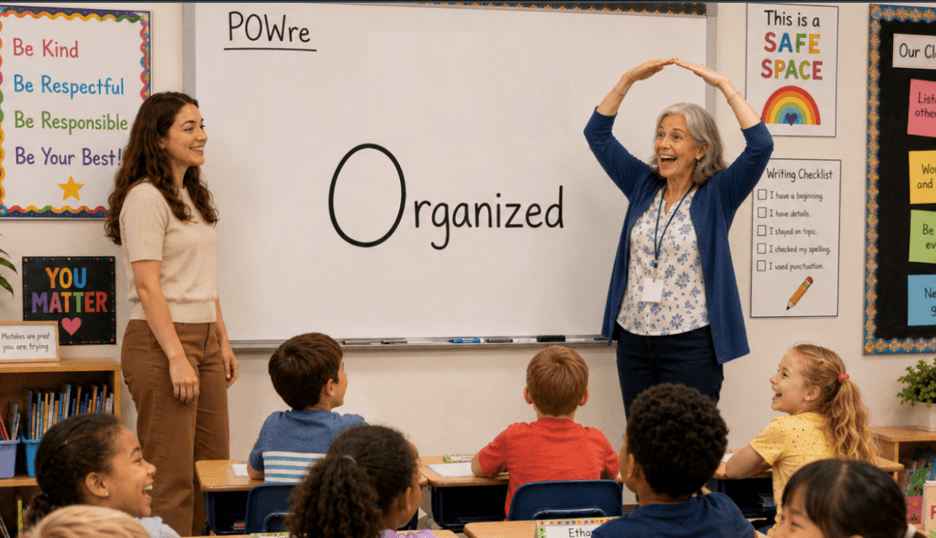
What Does SRSD Actually Look Like in a Classroom?
When teachers first hear about Self-Regulated Strategy Development, or SRSD, they often understand the promise before they understand the practice. They may hear that SRSD has a substantial research base, that it improves students’ writing, and that it includes memorable strategies such as POW, TREE, TIDE, or C-SPACE. Yet many teachers are still left with the most practical question of all: What does implementing SRSD in the classroom actually look like when students and teachers are using it in a real setting?
That question matters because SRSD can sound more complicated than it feels once teachers see it in action. At its core, SRSD is not a boxed curriculum, a rigid script, or a collection of acronyms. It is an evidence-based instructional framework that helps teachers make the often-invisible work of writing visible, understandable, and manageable for students.
Dr. Karen Harris, who developed SRSD, describes it as a flexible instructional model that combines explicit writing strategies with self-regulation. Her 2024 review, “The Self-Regulated Strategy Development Instructional Model: Efficacious Theoretical Integration, Scaling Up, Challenges, and Future Research,” traces the development of SRSD, summarizes its research base, and explains how the framework brings together strategy instruction, metacognition, motivation, and gradual release.
The central idea is straightforward: students, especially those with learning differences, should not have to discover the writing process by themselves.
SRSD Makes the Invisible Work of Writing Visible
In many classrooms, students are asked to write before anyone has shown them how an experienced writer actually thinks through the task. A teacher may explain the prompt, review a rubric, provide a graphic organizer, and tell students to begin. Some students can take it from there, but many cannot.
They stare at the page. They produce one sentence and stop. They list ideas without developing them. They wait for the teacher to tell them what comes next. They may recognize good writing when they read it, but they do not yet know how to create it independently.
SRSD changes that by asking teachers to make their thinking public. Instead of quietly completing a plan and showing students the finished product, the teacher models the decisions involved in planning, drafting, revising, and managing frustration.
A teacher modeling an opinion paragraph might say:
“I know my opinion, but my reader will need strong reasons. I have one idea, but it is too general. I need to explain why that reason matters.”
The teacher might then pause and add:
“I am getting stuck here. That happens to writers. I am going to return to my plan and ask myself what my reader still needs to understand.”
This is explicit instruction in metacognition. Students see that successful writers do not simply know what to say from the beginning. Successful writers pause, reconsider, make choices, return to their plans, and talk themselves through difficulty.
This kind of visible thinking is the heart of SRSD modeling: teachers reveal their own thoughts, decisions they make, obstacles they encounter, and self-corrections so students can begin to internalize those processes.
What the Teacher Is Doing
From the teacher’s perspective, SRSD is active and responsive. The teacher does not merely assign writing and circulate around the room. The teacher models, guides, questions, listens, assesses, collaborates, and gradually reduces support as students gain control.
One of the most visible features is the teacher think-aloud. The teacher shows students how writers generate ideas, organize information, decide what a reader needs, evaluate whether a reason is strong enough, and revise when the writing is unclear. Just as importantly, the teacher models the emotional and self-regulatory side of writing: how to remain focused, what to say when the work feels difficult, and how to recover when an idea does not work.
Modeling in SRSD is also interactive. It is not supposed to be a long performance in which students sit silently while the teacher writes. Students may help generate ideas, identify the next strategy step, suggest useful self-statements, or evaluate whether the developing composition meets its goal.
Barbara Friedlander explains this interactive form of modeling and the gradual release of support in the video “Modeling and Gradual Release in SRSD.” Her explanation is especially helpful for teachers who worry that explicit modeling means students become passive.
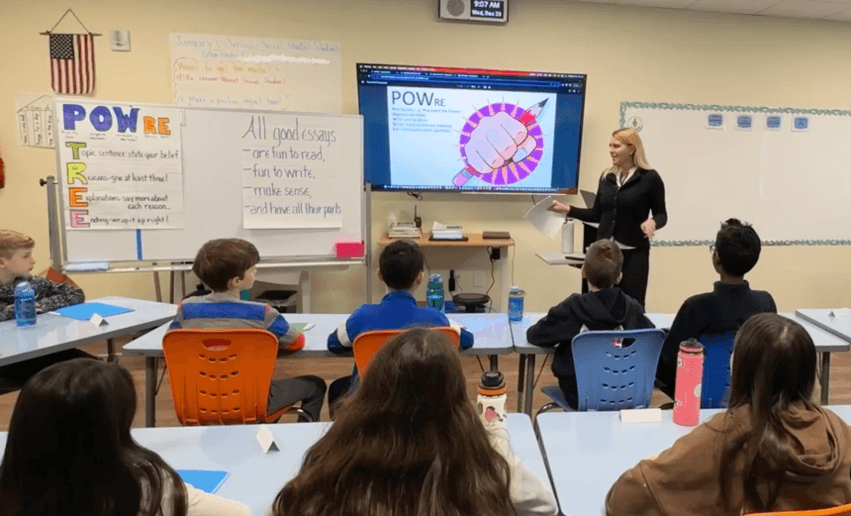
Teachers also introduce genre-specific strategies. In opinion writing, students may learn TREE. In informative writing, they may learn TIDE. In narrative writing, they may use strategies such as WWW or C-SPACE. These mnemonics help students remember what effective writing includes, but the mnemonic is only one part of SRSD.
Students must also learn why the strategy matters, how to use it, how to assess whether it is working, and how to adapt it as their writing becomes more sophisticated. Memorizing letters without modeling, guided practice, self-regulation, and gradual release would not represent full SRSD instruction. Here is a modeling video in which the teacher introduces the strategies POWre and TREE. Click on the image to view the video:
SRSD Is Systematic, but It Is Not Scripted
This distinction matters enormously.
Dr. Harris’s SRSD Resources and Information List explains that professional-learning lesson plans are intended as guides for teachers, parents, and tutors. They are not scripts to be read word for word to students. At the same time, flexibility does not mean removing the essential elements of the framework.
Teachers preserve the major instructional characteristics of SRSD while adjusting pacing, examples, grouping, intensity, peer collaboration, goals, and scaffolds according to student needs.
Two strong SRSD classrooms may therefore look different. One teacher may use more oral rehearsal. Another may spend additional time building background knowledge. A third may use more peer collaboration or provide more intensive support for students who struggle with executive function.
This is teacher ownership at work, and it is exactly what fidelity to SRSD looks like in practice.
The framework gives teachers a strong architecture while preserving their professional judgment and confidence. Fidelity means maintaining the essential principles of SRSD, not making every classroom look identical.
What the Students Are Doing
An SRSD classroom is not a place where students sit quietly while the teacher performs all the intellectual work. Students participate throughout the process. They contribute ideas, help analyze examples, discuss writing choices, rehearse plans with partners, and apply strategies to their own work.
Students may use graphic organizers to map out ideas before drafting. They may set a goal, such as including three strong reasons or explaining each reason clearly. They may use a checklist to evaluate whether their writing contains the elements they intended to include. Younger students may rehearse strategy steps through chants or songs until the process becomes easier to remember.
The classroom overview describes students contributing examples, discussing plans with peers, setting and checking goals, and using self-statements such as “I can do this” or “Stay focused and keep going.”
That self-talk is not an extra motivational activity added to the real writing instruction. It is part of the writing instruction.
Writing requires students to manage attention, effort, frustration, decision-making, and revision. A student may understand the parts of an essay but still struggle to begin. Another may have strong ideas but become overwhelmed when asked to organize them. Another may finish a draft and resist rereading it because revision feels confusing or threatening.
SRSD teaches students to manage those moments by connecting self-talk to concrete actions. A student might say, “I can take this one step at a time,” and then return to the plan. Another might say, “I need to explain this reason,” and use the genre strategy to identify what is missing.
The goal is for the questions once asked by the teacher to become questions students eventually ask themselves:
- What is my goal?
- What part comes next?
- Does my reader have enough information?
- Where could I add more?
- What can I do when I get stuck?
Collaboration Supports Independence
Explicit strategy instruction is sometimes misunderstood as rigid or entirely teacher-directed. In practice, SRSD can be highly collaborative.
Teachers and students may analyze examples together, generate ideas as a class, rehearse language, compare possible reasons, and discuss what a reader needs. Students may work with partners to talk through a plan before writing or offer feedback using language they have learned through the strategy.
This collaboration can lower the risk students associate with writing. Many students worry about being wrong, sounding foolish, or not knowing what to say. Talking through ideas gives them language before they must produce polished writing independently.
Peer support is also part of the broader SRSD research and instructional tradition. The book The Power of Peers in the Classroom: Enhancing Learning and Social Skills, edited by Karen Harris and Lynn Meltzer, explores how structured peer interaction can support both learning and social development.
Working through ideas with others is often what makes independent writing possible later.
SRSD Does Not Remove Creativity
One concern teachers raise is that strategies, mnemonics, and graphic organizers will make student writing formulaic.
That can happen when instruction stops at filling in boxes. But that is not the purpose of SRSD.
Structure is not the enemy of creativity. For many students, structure creates the conditions in which creativity becomes possible. A student who uses all available mental energy trying to remember what belongs in an essay has little cognitive space left for voice, nuance, elaboration, or originality.
When students internalize a process, they can devote more attention to the ideas they want to communicate and how they want to express them.
A narrative strategy may remind students to include characters, setting, goals, actions, and reactions, but it does not dictate the story. An opinion strategy may remind students to state a topic, give reasons, explain those reasons, and provide an ending, but it does not determine the student’s position, evidence, or voice.
The strategy gives students enough structure to avoid becoming lost. Teachers can then help them elaborate, adapt, experiment, and make the writing their own.
What SRSD Looks Like Changes with the Learner
SRSD has been studied and applied from the primary grades through high school, in general education, special education, intervention, and content-area settings. The basic principles remain consistent, but classroom implementation should develop with the learner.
In an early elementary classroom, SRSD may involve oral rehearsal, shared writing, drawing, songs, highly visible strategy supports, and extensive teacher modeling. In upper elementary classrooms, students may use strategies to develop arguments, explain information, or write from source texts. In middle and high school, the texts and strategies become more sophisticated, but the instructional movement remains recognizable: make the thinking visible, teach a strategy, build self-regulation, practice collaboratively, and move toward independence.
The research article “Yes, They Can”, by Harris, Kim, Yim, Camping, and Graham, examined the integration of oral language, transcription, close reading, and informative writing with first- and second-grade students. The work demonstrates that young children can engage in sophisticated reading-to-write instruction when teachers provide appropriate modeling and support.
At the secondary level, the federal practice guide Teaching Secondary Students to Write Effectively gives strong support to explicitly teaching writing strategies through a model-practice-reflect cycle, an instructional pattern closely aligned with SRSD.
Responsibility Gradually Shifts to Students
The gradual transfer of responsibility may be the defining feature of an SRSD classroom.
At first, the teacher performs much of the cognitive work in public. Students observe, respond, and contribute. Then the teacher and students work together, with the teacher providing prompts and support. Eventually, students take increasing control over planning, drafting, evaluating, and revising.
This transfer is not a rigid one-time progression from “I do” to “we do” to “you do.” Support changes according to readiness. A student may first use a detailed graphic organizer, then a shortened checklist, then only the mnemonic, and eventually no visible support at all.
Similarly, the teacher may initially ask every guiding question. Later, the student begins to ask those questions internally.
The goal is not for students to become good at completing an organizer. The goal is for them to become self-directed writers.
The video “From Training Wheels to Independence: What SRSD Looks Like in Real Classrooms” offers a helpful real-world view of this process. Carlton Bradshaw and Jayna Harrison describe how SRSD began in one school, what educators learned during implementation, and how the work expanded across multiple elementary buildings.
What You Might Hear in an SRSD Classroom
The language used by teachers and students often reveals the deepest change.
A teacher may say, “Watch what I do when I do not know how to begin,” or “I have a reason, but I have not explained it yet.” The teacher may ask, “What does my reader still need?” or model returning to a plan when the draft begins to wander.
Students may say, “That reason does not really match my opinion,” “I need another explanation,” “I forgot my ending,” or “Let me check my goal.”
These statements show that students are developing a language for thinking about writing.
Once teachers and students share that language, feedback becomes much more precise. Instead of telling a student to “make it better,” the teacher can ask which explanation needs more detail. Instead of saying a story is confusing, the teacher can ask what the character wants and what happens because of that goal.
The feedback becomes actionable because it connects to knowledge and strategies students have already learned.
SRSD Works with Existing Curriculum
SRSD does not require teachers to abandon the curriculum, texts, units, or workshop structures they already use. It supplies the explicit instructional “how”: how to model the thinking, teach a strategy, build self-regulation, support guided practice, and help students become independent.
The existing content, curriculum, and Writers’ Workshop routines all stay in place. SRSD strengthens how students learn to write within those structures.
The video “How Does SRSD Boost Writers’ Workshop?” addresses this connection directly. The SRSD Online Mentor Series also includes videos on process writing, modeling, assessment, genre knowledge, reading strategies, and self-regulation.
These examples reinforce an important point: SRSD is not one more curriculum competing for space. It is a framework for teaching the writing already required.
Learning SRSD Requires More Than a Strategy Chart
Because SRSD is more than a mnemonic or worksheet, teachers need more than a short presentation and a set of materials to implement it well.
Research on practice-based professional development suggests that teachers benefit from sustained opportunities to work through the stages of SRSD, practice modeling and self-regulation, use the materials they will teach with, plan for their own students, and receive feedback.
The SRSD Resources and Information List summarizes this professional-development research and points to studies by Harris, McKeown, Graham, Camping, and their colleagues. One particularly relevant study is “Teachers’ Voices: Perceptions of Effective Professional Development and Classwide Implementation of Self-Regulated Strategy Development in Writing,” which examines teachers’ experiences learning and implementing SRSD.
This matters because the goal is not simply for teachers to know what SRSD is. They must become comfortable making their thinking visible, teaching self-regulation, differentiating support, and gradually transferring responsibility.
What Changes for Students
The most important change is not simply that students remember a strategy. It is that writing becomes less mysterious.
Students begin to understand that successful writing is not a talent some people possess and others do not. It is a process that can be learned, practiced, monitored, and improved.
A blank page no longer represents total uncertainty because the student has a place to begin. A weak first draft no longer represents failure because revision is part of the process. Becoming stuck no longer has to mean, “I am not a writer.” It can mean, “I need to return to my strategy.”
Teachers sometimes report that students who previously avoided writing begin asking for more time because they finally know how to move forward. That should not be treated as a universal promise, but it captures an important possibility. When students experience genuine control and progress, their relationship with writing can change.
The Simplest Way to Understand SRSD
SRSD does not make writing easier by lowering the intellectual demand. It makes writing more manageable by teaching students how to handle that demand.
Teachers make their thinking visible. Students learn strategies for different writing purposes. The class practices together. Students use goals, self-talk, self-monitoring, and feedback. As their competence grows, the teacher gradually reduces support.
That is what SRSD looks like in a classroom.
It is not a poster on the wall, a mnemonic by itself, or a graphic organizer students complete forever. It is a way of teaching students how writers think, how writers manage difficulty, and how writers improve their work over time.
When students finally know what to do when they become stuck, the classroom changes. Their writing can improve, but something even more important begins to happen as well.
The writer changes.
References
Harris, K. R. (2024). The Self-Regulated Strategy Development instructional model: Efficacious theoretical integration, scaling up, challenges, and future research. Educational Psychology Review, 36, Article 104.
Harris, K. R. (2024). SRSD resources and information list. ResearchGate.
Harris, K. R., & Meltzer, L. (Eds.). (2015). The power of peers in the classroom: Enhancing learning and social skills. Guilford Press.
Harris, K. R., Kim, Y.-S., Yim, S., Camping, A., & Graham, S. (2023). Yes, they can: Developing transcription skills and oral language in tandem with SRSD instruction on close reading of science text to write informative essays at grades 1 and 2. Contemporary Educational Psychology, 73, 102150.
What Works Clearinghouse. (2016). Teaching secondary students to write effectively (WWC Practice Guide). Institute of Education Sciences, U.S. Department of Education.

About the Author
Randy Barth is CEO of SRSD Online, which innovates evidence-based writing instruction grounded in the Science of Writing for educators. Randy is dedicated to preserving the legacies of SRSD creator Karen Harris and renowned writing researcher Steve Graham to make SRSD a standard practice in today’s classrooms. For more information on SRSD, schedule a risk-free consultation with Randy using this link: Schedule a time to talk SRSD.


