How the Science of Writing Can Improve Your Skills
SRSD Online Helps Schools Cross the Finish Line
Carl Hendrick recently asked a question that should be at the center of every serious literacy conversation: Is there a science of writing?
In his blog his answer is thoughtful, careful, and important. Yes, there is a science of writing, but it does not look exactly like the science of reading. It is broader, harder to package, and resistant to slogans, and it does not reduce easily to one clean model or one biological mechanism. And because of that, it has not yet shaped policy, teacher preparation, public conversation, or classroom practice with the same force that the science of reading has.
I think Hendrick is right.
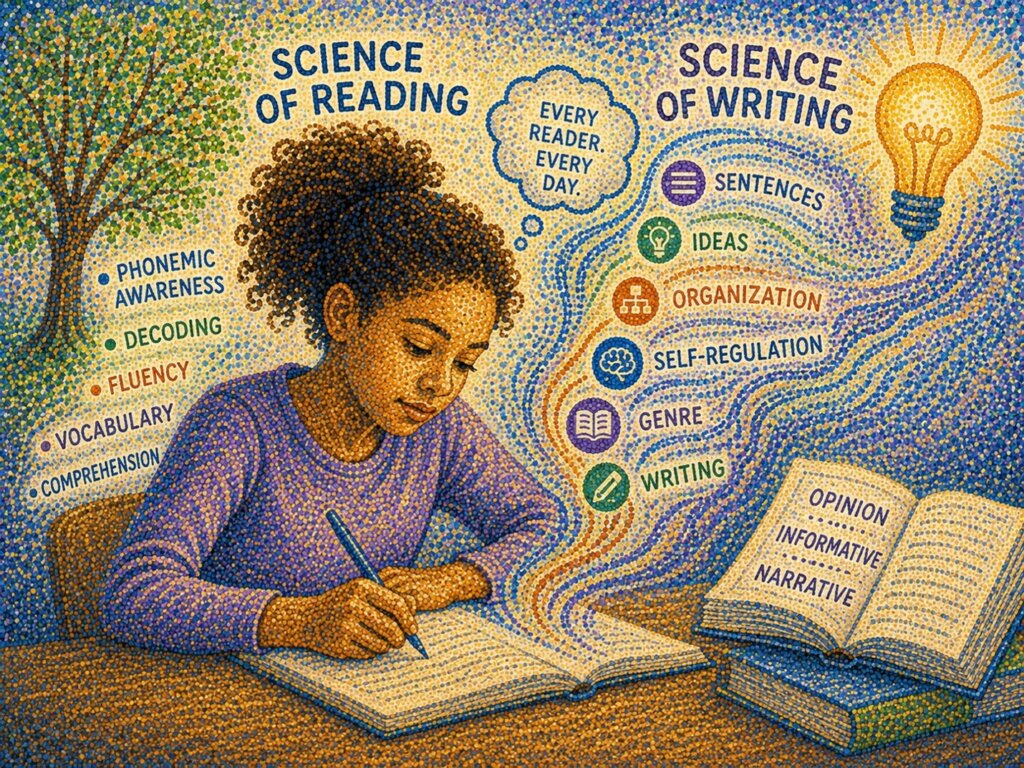
For the past decade, the science of reading has dominated literacy discussions across the United States and other English-speaking education systems. That movement has helped schools pay long-overdue attention to decoding, phonemic awareness, fluency, vocabulary, background knowledge, and comprehension. It has changed laws. It has influenced curriculum decisions. It has pushed teacher preparation programs to examine what future teachers learn about reading.
That work matters, but reading is only one side of literacy.
A student who can decode fluently but cannot explain an idea, summarize information, defend a position, write a coherent paragraph, or communicate clearly in writing still needs something essential. Reading allows students to receive knowledge. Writing allows them to work with knowledge. Writing asks students to select, organize, explain, question, connect, and contribute. It turns thinking into something visible.
Hendrick makes this point beautifully when he argues that writing allows students to offer what Bakhtin called the “answering word.” I love that phrase because it captures what is at stake. Writing is not merely a school task. It is how students enter the conversation. It is how they clarify what they think, test what they believe, and offer something meaningful to others.
That is why the science of writing deserves a much larger place in the literacy movement.
But Hendrick also helps explain why that has not happened yet. The science of reading has a simpler public story. The brain is not built to read. Children must be taught how print maps onto speech. That does not make reading simple, but it gives the movement a clear anchor.
Writing has no equivalent single anchor.
Writing requires students to coordinate oral language, transcription, spelling, vocabulary, syntax, sentence structure, genre knowledge, background knowledge, audience awareness, planning, motivation, revision, and self-regulation, all of which are critical aspects of language development. A young writer must manage all of this while holding ideas in working memory and trying to produce language that makes sense to someone else.
That is an enormous cognitive task.
Teachers see this every day. A student may have a good idea but struggle to put it into words. Another student may write one sentence but lose control when asked to build a paragraph. Another may list facts but fail to explain their importance. Another may begin with confidence but shut down when the task becomes demanding. These students are not lazy. They are not incapable. They are often overloaded.
Hendrick captures this when he describes writing as the management of cognitive load rather than the exercise of any single skill. That observation should change how schools teach writing.
If writing overloads students, then simply assigning more writing will not solve the problem.
We have to teach writing.
We have to teach it explicitly, strategically, and systematically: breaking it into parts students can hold and modeling the thinking writers use. We have to give students strategies they can remember, support them as they practice, and help them take control gradually.
This is where Hendrick’s blog becomes especially valuable. He argues that the strongest findings in writing research are not just about how children acquire writing, but about what kinds of instruction improve writing. That distinction matters. The science of writing may be complex, but the instructional implications are clear enough for schools to act.
We know sentence-level instruction matters, an insight Hendrick traces to Hochman and Wexler’s The Writing Revolution, which treats the sentence as the building block of writing and thought.
We know students benefit from learning how sentences carry relationships between ideas. Words like because, but, so, although, unless, while, and even though are not decorative grammar terms. They are tools for thinking. They teach cause, contrast, consequence, condition, concession, and connection.
When a student writes, “Recess is good,” we see an idea beginning to form. When that student writes, “Recess helps students focus because movement gives their brains a break,” the thinking becomes clearer. The sentence now explains. It connects an idea to a reason. It gives the reader something to understand.
That is why the “cognitive levers” Hendrick highlights, a term he draws from David Didau and Rikki Cole’s work on sentence-level instruction, are so important. Sentence structures can shape thought, requiring students to explain, contrast, reconsider, qualify, or extend an idea. When we teach sentences well, we are not just teaching grammar; we are teaching students how to think with precision.
But strong writing instruction cannot stop at the sentence.
Students also need to learn how sentences build paragraphs and how paragraphs build full compositions. They need to understand that different genres make different demands. Opinion writing asks students to take a position, give reasons, explain those reasons, and bring the piece to a clear conclusion. Informative writing asks students to identify important ideas, organize information, elaborate, and teach the reader something meaningful. Narrative writing asks students to develop characters, setting, events, problems, responses, and endings in ways that create meaning.
Students do not automatically understand those differences; they need instruction.
This is where Self-Regulated Strategy Development, or SRSD, becomes essential.
Hendrick identifies SRSD as one of several evidence-based traditions in writing instruction, alongside The Writing Revolution and Direct Instruction, all backed by extensive research in writing techniques. He describes it as a way to teach, model, memorize, support, and gradually release strategies to develop writing skills rather than treating writing as something students simply discover through exposure. That description matters because it gets to the heart of SRSD.
SRSD does not treat writing development as a mystery; it gives teachers a way to make the invisible work of writing visible.
Strong writers make decisions constantly. They ask themselves: What am I trying to do? What does this genre require? What do I know? What does my reader need? How should I organize my ideas? Have I explained enough? What can I do if I get stuck? How do I know whether this writing works?
Many struggling writers do not ask those questions automatically. SRSD teaches them how.
The six stages of SRSD provide a clear instructional path: develop and activate background knowledge, discuss it, model it, memorize it, support it, and move students toward independent performance. Those stages are not a rigid script. They are a teaching framework. They help teachers reduce cognitive load, model the thinking process, and release responsibility as students gain control.
That last phrase matters: gain control.
The goal of SRSD is not to produce formulaic writers. The goal is to help students internalize the strategies and self-talk that strong writers use so they can eventually write with greater independence, flexibility, and confidence.
Some people hear “strategy instruction” and worry that structure will limit student voice. I understand the concern, but it misunderstands the purpose of scaffolding. A scaffold is not the building. It helps the building rise. Students do not lose voice because they learn how to organize their thinking. They gain the ability to make their voice clearer.
A student who cannot organize ideas cannot fully express voice, and a student who cannot explain a reason cannot fully defend a belief.
Without the ability to build a sentence, a student cannot fully communicate a thought.
Explicit instruction does not crowd out thinking. It creates space for thinking by reducing the load around it.
That is one of the most powerful insights in Hendrick’s essay, and it is one of the reasons SRSD matters so much. Writing places extraordinary demands on working memory. SRSD gives students routines, strategies, mnemonics, models, and self-regulation tools so they do not have to hold everything in mind at once. The strategy carries some of the load until students can carry more of it themselves.
At SRSD Online, we believe this is where the science of writing has to go next.
The field does not need another slogan. Teachers do not need another abstract call to “improve writing.” Schools do not need one more initiative that identifies the problem but leaves implementation vague.
Teachers need a system.
They need professional learning that helps them understand the science of writing and then shows them how to act on it: classroom-ready materials, genre-based unit plans, modeling support, and student-facing tools. They also need coaching structures and observation and reflection tools, along with leadership guidance so writing improvement does not depend on one enthusiastic teacher working alone.
That is why SRSD Online exists.
Our work begins with the research, but it does not stop at the research. We help schools translate evidence into instruction. We help teachers learn how to model writing, teach genre strategies, build self-talk, support sentence-level growth, guide students through planning and drafting, and release responsibility over time. We help coaches know what to look for. We help leaders understand what implementation requires. We help schools move from isolated writing activities to a coherent writing system.
That is what I mean when I say SRSD Online takes the science of writing to the finish line.
Research starts the race. Implementation finishes it.
A meta-analysis cannot model a lesson for a teacher on Tuesday morning. A research chapter cannot sit beside a coach and help interpret student writing samples. A theoretical model cannot automatically create a schoolwide plan for training, practice, coaching, and sustainability.
Schools need the research, but they also need the bridge from evidence to daily practice, and that is the bridge SRSD Online builds.
This is especially important because writing instruction has too often lived in fragments. One teacher emphasizes grammar, another leans into creative expression, and another builds around prompts and rubrics. Still others focus on test preparation or process writing, or simply give students more time to write with little direct instruction. Each teacher may care deeply, but students experience inconsistency.
SRSD gives schools shared language.
It gives teachers a common way to talk about genres, strategies, modeling, self-talk, planning, support, independence, and student progress. It gives students tools they can carry from one classroom to another. It gives leaders something more concrete to support than “better writing.”
That does not mean every classroom looks identical. SRSD is criterion-based, not calendar-bound. Teachers still make professional decisions. If students need more modeling, the teacher models again. If students need sentence-level work before moving into full paragraphs, the teacher strengthens that foundation. If students are ready for independence, the teacher releases more responsibility. If students need enrichment, the teacher helps them make more mature craft and organizational choices.
Structure and responsiveness work together, and that is the kind of writing instruction schools need.
Hendrick also raises an equity argument that deserves serious attention. Explicit writing instruction is not enrichment for students who already sound articulate. It is access for students who need school to teach the language patterns, sentence structures, and organizational tools that others may have absorbed outside school.
This may be the most urgent reason to take the science of writing seriously.
Some students enter school with years of exposure to elaborated language, extended explanations, complex syntax, academic vocabulary, debate, storytelling, and adult conversation. Other students enter with less exposure to the language patterns that map easily onto academic writing. That difference is not a difference in intelligence or potential. It is a difference in opportunity.
If schools do not conduct a consistent assessment of writing skills and teach writing explicitly, those opportunity gaps widen.
Students who already know how written language sounds continue to move ahead. Students who need direct access to that language are told to write more, revise more, or try harder. That is not enough.
Explicit writing instruction gives students access to the tools of written thought.
It teaches them how to build sentences that explain, contrast, and connect, and how to organize ideas across a paragraph. It teaches them how to develop reasons, elaborate information, bring writing to a meaningful close, and know what to do when they get stuck. Writing is not magic. It is a set of learnable moves.
That belief sits at the center of SRSD Online: writing can be taught, teachers can learn to teach it powerfully, and students who struggle with writing can grow dramatically when they receive the right instruction. Schools need systems that make evidence-based writing instruction practical, sustainable, and scalable. The science of reading movement reminded us that children need explicit instruction to become skilled readers; the science of writing should now remind us that children also need explicit instruction to become skilled writers. We cannot leave writing to chance, treat it as something students simply pick up along the way, wait until state testing reveals the problem, or try to solve weak writing by assigning more essays without teaching students how essays work. We need to teach writing with the same seriousness, clarity, and commitment that we now bring to reading.
Carl Hendrick’s blog helps move that conversation forward. He gives the field a useful framing: the science of writing exists, but it is less unified, less publicly understood, and harder to implement than the science of reading. He also points us toward what instruction must include: sentence-level teaching, cognitive levers, explicit instruction, genre awareness, and SRSD.
I would add one more point: the science of writing will not change classrooms until schools have an implementation system.
That is the work ahead. At SRSD Online, we help schools turn the science of writing into daily classroom practice by giving teachers the training, tools, and support to teach writing explicitly and confidently. Students should not experience writing as confusion or defeat; they should experience it as a way to think clearly, enhance their communication skills, and participate in the world around them. To get there, schools need to teach sentences as tools for thinking, make genre structures visible, model the decisions writers make, build students’ self-talk and planning routines, support practice carefully, and release responsibility over time. The science of writing is real, but it only matters when it reaches classrooms. Reading helps students understand what others have written. Writing helps them contribute what only they can say. Every child deserves both.

About the Author
Randy Barth is CEO of SRSD Online, which innovates evidence-based writing instruction grounded in the Science of Writing for educators. Randy is dedicated to preserving the legacies of SRSD creator Karen Harris and renowned writing researcher Steve Graham to make SRSD a standard practice in today’s classrooms. For more information on SRSD, schedule a risk-free consultation with Randy using this link: Schedule a time to talk SRSD.


