Students Can Explain the Text. So Why Can’t They Write About It?

How Explicit Writing Instruction Helps Students Turn Understanding into Words
Explicit teaching is part of today’s conversation about effective instruction. Here’s what explicit writing instruction looks like, and why it doesn’t have to be scripted.
A fourth grader has just explained exactly how trees help cool a city. Now there is a blank page in front of him, and he has no idea what to write.
During the discussion, he had plenty to say. Trees provide shade. Streets get hot in the sun. People feel more comfortable when they can get out of the heat.
But when the teacher asks him to write a paragraph, he manages one sentence:
“Trees are good for cities.”
Then he stops.
Imagine being his teacher. You heard his explanation, and you know there is something there to work with. It would be so easy to say, “You just told me the answer. Write that down.”
Yet that moment deserves a closer look. What helped him explain his thinking during the conversation? And what does he need to be shown so he can get that thinking onto the page?
Students in his position often have ideas. What many still lack is a way to decide which ideas belong on the page and how to explain them so a reader understands. Those decisions are mostly invisible, so students are left to guess at them.
Students need teachers to make that thinking visible, and teachers need room to respond to what their students show them.
Why This Conversation Is Happening Now
You may have heard educators discussing Sold a Story, the investigative podcast from APM Reports, hosted by Emily Hanford. The second season, What Happened to Teaching, looks more broadly at teaching through the story of Siegfried “Zig” Engelmann and Direct Instruction.
The new season has prompted discussion about Direct Instruction, instructional scripts, and what effective teaching looks like.
My reaction was immediate: Let’s make sure writing is part of this conversation.
Direct Instruction is a specific model, with carefully sequenced lessons and scripted teaching routines. Explicit instruction is a broader approach to making learning clear through explanation, modeling, supported practice, and feedback.
With SRSD (Self-Regulated Strategy Development), writing instruction is explicit. Students see and hear the thinking behind writing, and teachers understand why each part matters, so they can adapt it to their own students.
Listen for What the Student Can Do
Before deciding how to help, the teacher needs to understand what happened during the discussion.

Did the student explain the passage independently, or did the teacher’s questions help him organize his answer? Did classmates offer language he could build on?
Then there is the writing itself. Perhaps he understands the information but cannot decide what belongs in the paragraph. Or perhaps he is trying to manage so many decisions at once, taxing his working memory and making it hard to find a place to begin.
Looking at that one unfinished sentence, we cannot yet know where he is getting stuck in the writing process.
Suppose the teacher discovers that this student understands the passage but needs help selecting and organizing information. Now the teacher has a useful place to begin.
Make the Thinking Visible With TIDE
The writing question is:
How can trees make a city more comfortable during hot weather?
The teacher brings the class back to that purpose and uses TIDE to help organize an informational response: a topic sentence, important ideas, detailed explanations, and an ending.
Instead of silently completing the plan and showing students the finished version, the teacher lets them hear the decisions:
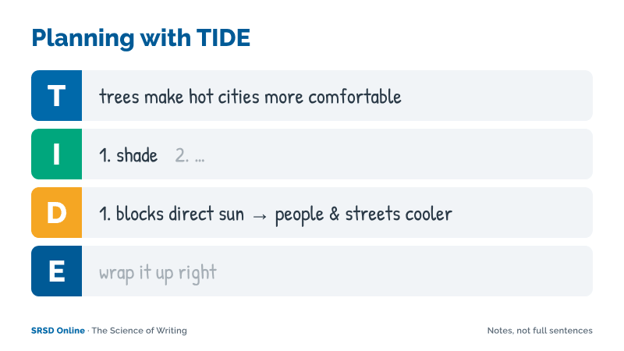
“I want my topic sentence to answer our question. ‘Trees are good’ is a start, but it is too broad. We are explaining how trees help during hot weather. I could write, ‘Trees help make cities more comfortable when the weather is hot.’”
Then the teacher returns to the passage:
“This detail says some trees have colorful leaves. I like that fact, but does it help answer our question? I don’t think it does. The detail about shade is more useful.”
Students can discuss why one detail belongs and another does not, rather than simply watching the teacher choose.
The teacher continues:
“I have written that trees provide shade. Now I need to explain why that matters. My reader needs the connection: shade protects people from direct sunlight and helps keep surfaces cooler.”
On the TIDE organizer, those decisions turn into a few short notes:
If you would like to explore that process further, “Reading to Learn and Then Write: Why Students Need Both” looks more closely at selecting information and turning it into a written response.
Explicit, Not Scripted: What the Difference Looks Like
A teacher might prepare those modeling lines before the lesson, drawing on their content knowledge to anticipate which decisions students need to hear and where they may need help. That preparation also makes room to listen and respond to students during the lesson.

If students cannot explain why the shade detail belongs, the teacher might compare another pair of details. If students understand relevance but struggle to elaborate, the teacher can spend more time showing how an explanation helps the reader.
The teacher begins the writing process with a clear goal and thoughtful planning. During guided practice, students’ questions and responses help the teacher decide when to offer more support, model again, or let students take the next step on their own.
The IES practice guide Teaching Secondary Students to Write Effectively (grades 6–12) recommends explicitly teaching writing strategies using a Model-Practice-Reflect cycle, gradually releasing responsibility as students use those strategies independently, and using assessments of student writing to inform instruction.
Teacher Judgment Belongs at the Center
Even a well-planned lesson can surprise you. A student’s question may reveal a misunderstanding. Another student, like our fourth grader, may explain aloud far more than he can write. And someone who seemed ready to work alone may need to practice with you again.
SRSD is an evidence-based approach in which teachers provide explicit writing instruction alongside self-regulation strategies. Students learn to set goals, monitor their work, use helpful self-talk, and how to keep working when they become stuck.
For this lesson, a student’s goal might be: I will explain how each detail helps answer the question.
The teacher can model checking that goal:
“I included my detail, but I haven’t explained it yet. Let me go back and help my reader understand.”
With teaching and practice, that question can become part of the student’s own thinking.
Help Students Carry the Thinking With Them
Eventually, our fourth grader faces another writing task.
The subject has changed, and the teacher is helping someone else. What can he do?
We want him to have somewhere to begin:
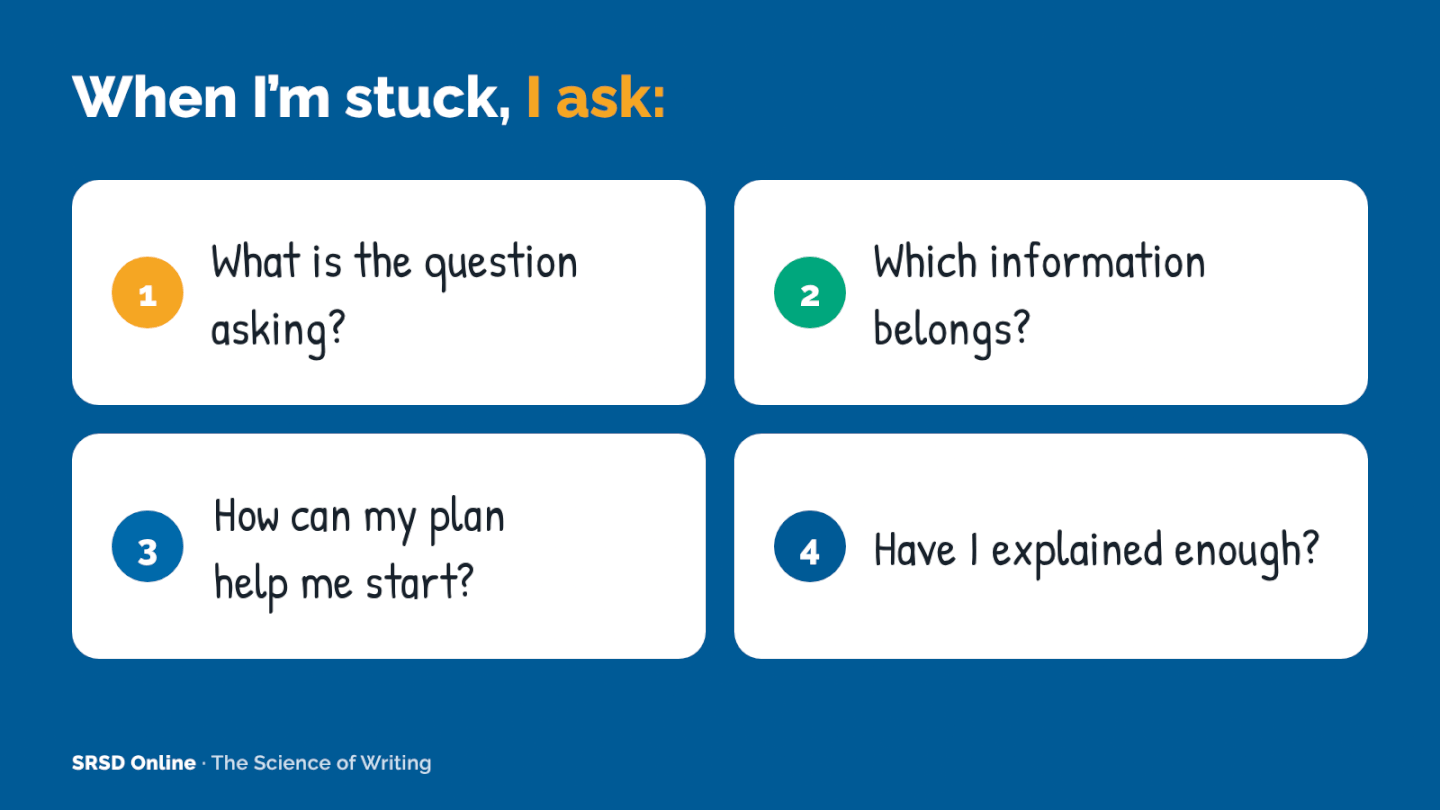
That is why this work matters beyond the paragraph about trees. We want students to carry what they have learned into the next assignment, the next subject, and the next classroom, with increasing independence.
Give Teachers the Support to Teach This Way
Of course, asking teachers to do this well means giving them opportunities to learn it themselves.
Teachers need time to rehearse, discuss those choices with colleagues, receive feedback, and keep learning as they teach. Our article on practice-based SRSD professional development explores what that preparation can involve.
When I spoke with The Hechinger Report about writing instruction, I raised the issue of how difficult it has been for writing to receive attention and investment. Helping teachers develop this kind of expertise is one meaningful place to put that investment.
Think again about that child who had so much to say and then stopped after one sentence. His ideas are worth hearing. With a teacher who listens, investigates, and shows him how to take the next step, he has a chance to learn how to share them on the page.
Explicit instruction, not scripted. It is clear enough to guide the learner and responsive enough to meet the child.
If you want to bring this kind of writing instruction to your teachers, explore SRSD Online’s professional learning.

About the Author
Randy Barth is CEO of SRSD Online, which innovates evidence-based writing instruction grounded in the Science of Writing for educators. Randy is dedicated to preserving the legacies of SRSD creator Karen Harris and renowned writing researcher Steve Graham to make SRSD a standard practice in today’s classrooms. For more information on SRSD, schedule a risk-free consultation with Randy using this link: Schedule a time to talk SRSD.


